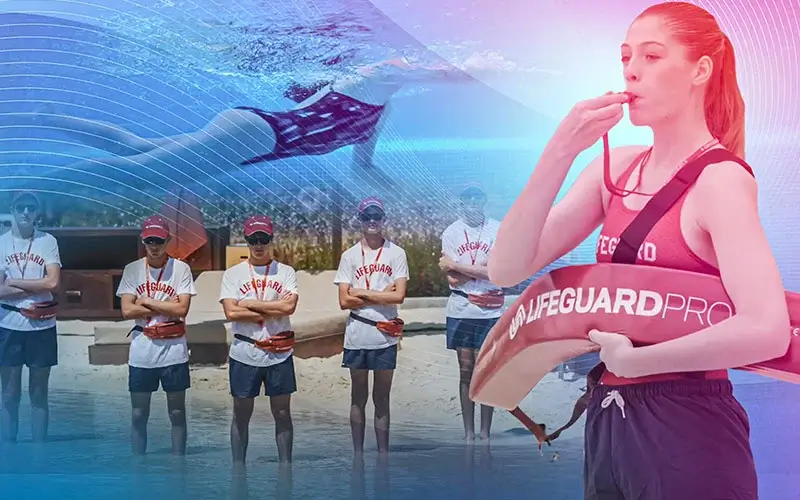

Securing a validated safety credential is the first regulatory requirement for professional safety management in modern civic urban centers and commercial waterfront infrastructure. As crowd layers increase at aquatic facilities and massive public pools, the ratio of active hazard indicators also increases rapidly on an automatic scale.
The largest functional gap between a standard emergency response worker and a normal public individual is their tactile muscle reaction and neurological hazard mapping network. Unless mechanical defense rules are properly tested under precise structural training loops, it is impossible to maintain zero-error management in acute drowning emergencies.
New responders entering these high-stress evaluation setups face considerable physical limits and computational coordination checkpoints in the early stages. Without formal structural parameters, learners are unable to handle sudden, involuntary panic attacks by victims in critical distress zones, which also causes their own floating stability index to rise to dangerous levels.
In addition, there is significant functional delay in applying life support for breathing kits and electronic cardiac assessment nodes according to automated guidelines in critical trauma scenarios. These processing barriers break down the overall rescue integrity, which can only be fully evaluated through a standard industry credentialing program.
Media Flash 2026: Tracking Evolution & Operational Integrity
State Health Enforcement Desk and Global Insurance Underwriting Groups have designated safety database transparency as a top priority in their 2026 Corporate Workplace Standard Blueprints. According to current regulatory circulars and global safety news networks, including recent Google News tracking feeds and Dynamic Naval Registry Bulletins, the American Lifeguard Association (ALA) has shifted its traditional authentication systems to highly secure cloud-encrypted reporting logs. The primary goal of this advanced technological change, according to Institutional Data Briefs, is to improve registration processing times and provide certified validated safety officers at every public hydro center.
International Leisure Network Bodies and Elite Shoreline Property Developers have called this advanced digital proximity to update a breakthrough in civil safety execution. Candidates no longer must travel long distances to remote testing centers to learn legal safety rules and behavioral rescue theory codes.
Advanced digital learning portals have been integrated at each area’s infrastructure level, as well as standard interactive instructor-led testing pools where applicants can directly complete the registration process. This logistical ease has significantly improved the Certified Assets scaling metrics, leading to the world’s largest hospitality groups placing great trust in ALA’s innovative authentication model.
Core Evaluation Parameters: Professional Performance Protocols
To complete this administrative credential track, each candidate must verify themselves to a zero-error standard under extreme physical parameters on practical testing pools:
- Subsurface Ballistic Extraction: Applicants deliver a 10-pound dummy body object from the bottom of deep water (approximately 10 feet deep) to the upper surface within a targeted narrow timeline without any external assistive tools.
- Neutral Spinal Stabilization Moves: When transporting victims with high-impact head or neck injuries from deep water layers to landside, backboard alignment is executed according to complete immobilization parameters to prevent secondary nerve damage.
- Rotational Surveillance Grid Scans: Scanning monitors are given the mechanical practice of continuously scanning subsurface blind spots under 10-second visualization intervals despite light reflections on pool surfaces and high crowd noise.
Corporate Benefits: Structural Protection and Career Growth
Having legitimate evaluation documents verified by the closest local authority board generates explicit financial and regulatory benefits for both professional specialists and facility operators:
Instant Reaction Calibration
The psychological fear response lag is completely cleared during emergency environments, and the safety responder’s muscle framework deploys preset defense maneuvers within fractions of seconds.
High-Tier Employment Onboarding
With valid global digital credentials active, personnel are provided with direct recruitment priorities at international luxury cruise lines, premium beachfront resort systems, and state-level naval parks.
Civil Lawsuit Protection
Transparent digital logging metrics and verified documentation papers securely shield enterprise heads from heavy civil negligence lawsuits, third-party penalty claims, and commercial operational closure risks.
Conclusion: System Integration and Enterprise Defense
Modern Environmental Behavior Modifications and Rapidly Dense Civic Crowd Layout have fully established that Validated Close Range Certified Active Readiness is the true foundation core of public health protection lines. Completing a core evaluation with an authorized monitoring board is not just a seasonal administrative target touch, but a highly scientific processing method for making the entire geometric community rescue grid independent and risk-free.
ALA’s decentralized hybrid validation structures are absolute concrete evidence of the legal reality that when manpower resources are trained and audited on cutting-edge physical parameters, the structural impact graph of unexpected aquatic hazards crashes to zero scale. The final standard of the entire technical setup is to align the sensory reflexes of each automated surveillance specialist to a level that allows them to always perform as a fail-safe vertical wall in the face of civic disaster environments.
Frequently Asked Questions (FAQs)
1. What are the basic requirements to register for this Professional Safety Credential Track? The official age criteria for candidates is 15 years of age. In addition, after completing the initial registration steps, the candidate must demonstrate continuous entry of swimming fitness to assess dynamic body endurance.
2. Can the legal theoretical criteria for this verification program be completed online?
Yes, according to the rules of the ALA’s Modern Blended Course Structure, you can complete the National Health Codes, Legal Civil Mandates, and Basic Safety Management Theories online on interactive digital dashboards, but practical validation is only possible after you pass the manual water testing drills at physical centers.
3. How long is a qualification certificate valid under workplace regulation laws? A certified validation document is considered valid for a maximum of 24 months (2 years) under Federal Labor Standardizations and Standard Health Enforcement Mandates, after which the roles must be refreshed by regulatory laws.
4. Does this core training infrastructure include high-level clinical trauma operations? Yes, this advanced technical infrastructure includes full hands-on practice of multi-rescuer cardiopulmonary resuscitation (CPR), automated external defibrillator (AED) operation configurations, air obstruction ventilation methods, and severe arterial pressure bleeding control (tourniquets).
5. What are In-Water Panic Breakaway Maneuvers? When a drowning victim in deep water holds onto a safety rescuer’s windpipe or upper arms due to severe stress, safety specialists use advanced wrist leverage drops and density shifts to safely break these holds without disrupting the rescue process.